Home
Science
πŸ‡°πŸ‡· πŸ‡ΊπŸ‡Έ πŸ‡―πŸ‡΅ πŸ‡¨πŸ‡³
Our Products Β· Dual-Axis System

We design structure
and environment simultaneously.

The structure cells recognize, the environment where regeneration occurs, and the delivery to complete it.

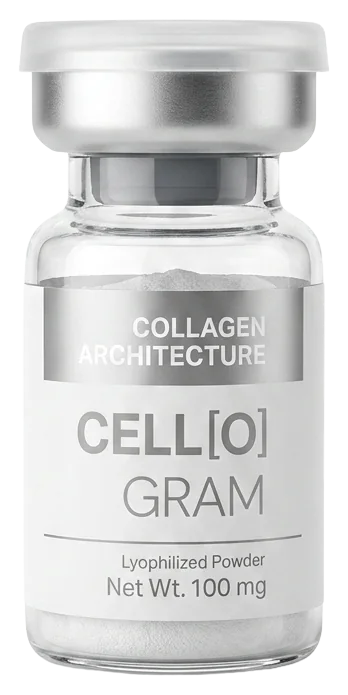
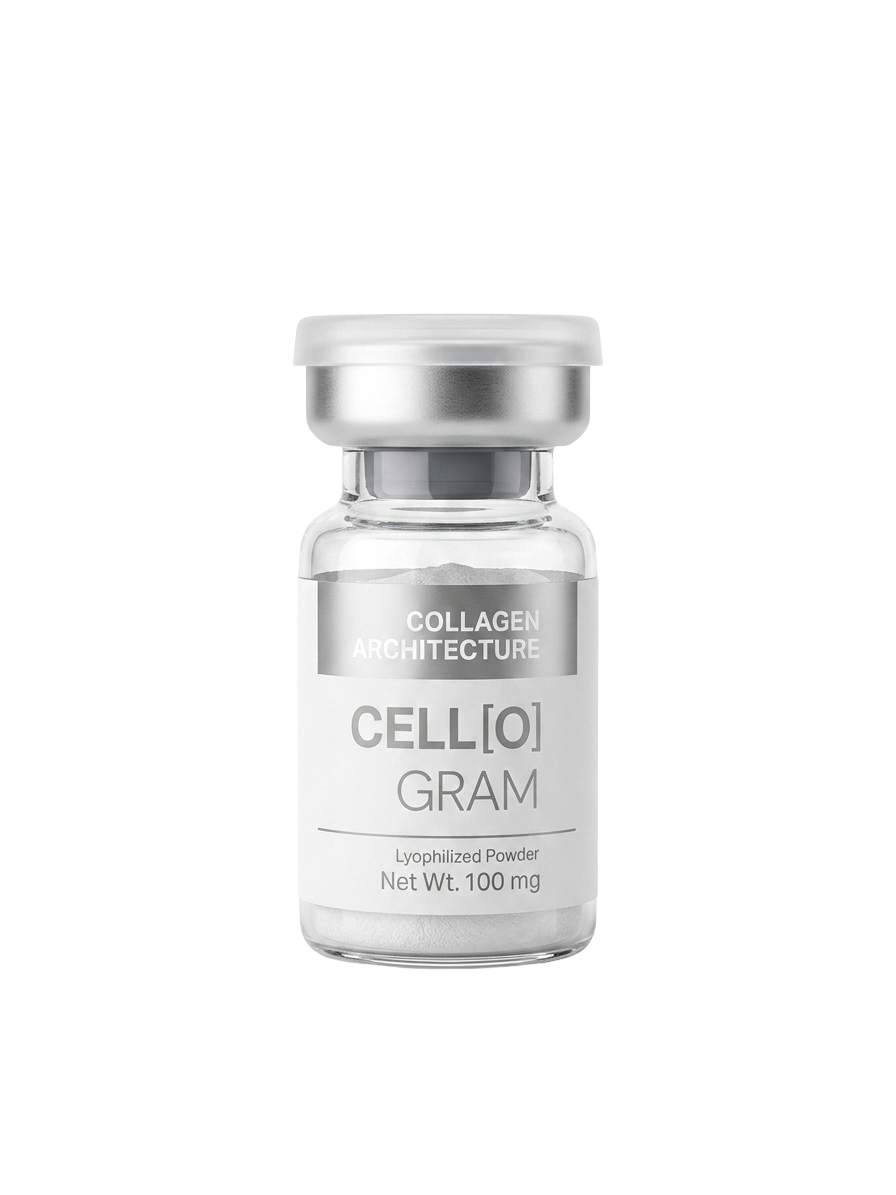
Vial 01 Β· Collagen Architecture
Collagen
Architecture
Structure β€” Structural foundation for collagen regeneration
FormLyophilized Powder
Content100mg / vial
Particle30Β΅m sphere
StructureNon-porous
Duration3–6 months
UseProfessional only
"30Β΅m β€” the size cells recognize. Not a chemical signal, but a physical structural signal."
PDLLA 30Β΅m microspheres are engineered to match the scale of dermal fibroblasts (20–30Β΅m). Their non-porous, high-density architecture maintains a uniform and predictable degradation rate, designing an environment where the skin regenerates on its own with minimal interference.
Mechanism of Action
01 Β· Implantation
Scaffold Placement
30Β΅m non-porous microspheres establish a physical foundation within the dermis.
02 Β· Recognition
M2 Polarization
Macrophages recognize the scaffold and polarize toward the M2 (anti-inflammatory/regenerative) pathway.
03 Β· Signaling
TGF-Ξ² Β· SMAD Pathway
M2 macrophages secrete TGF-Ξ², activating fibroblasts through the SMAD signaling pathway.
04 Β· Remodeling
Collagen Synthesis
Activated fibroblasts synthesize Type I/III collagen. Structural remodeling progresses around the scaffold.
Non-porous architecture allows surface-only degradation, maintaining a uniform collagen formation environment.
Inflammatory cell count at 12 weeks: 1/6 the level compared to porous structures.
Inquire About This Product  →
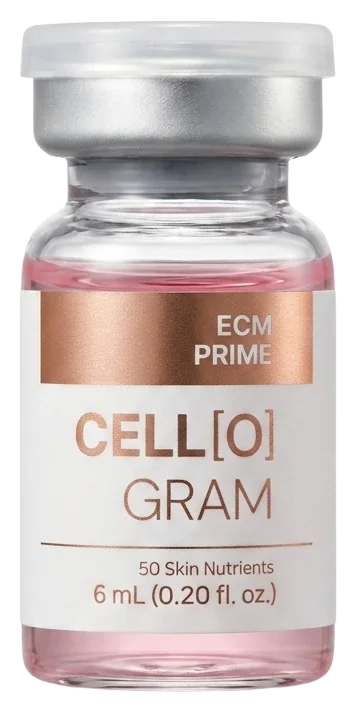
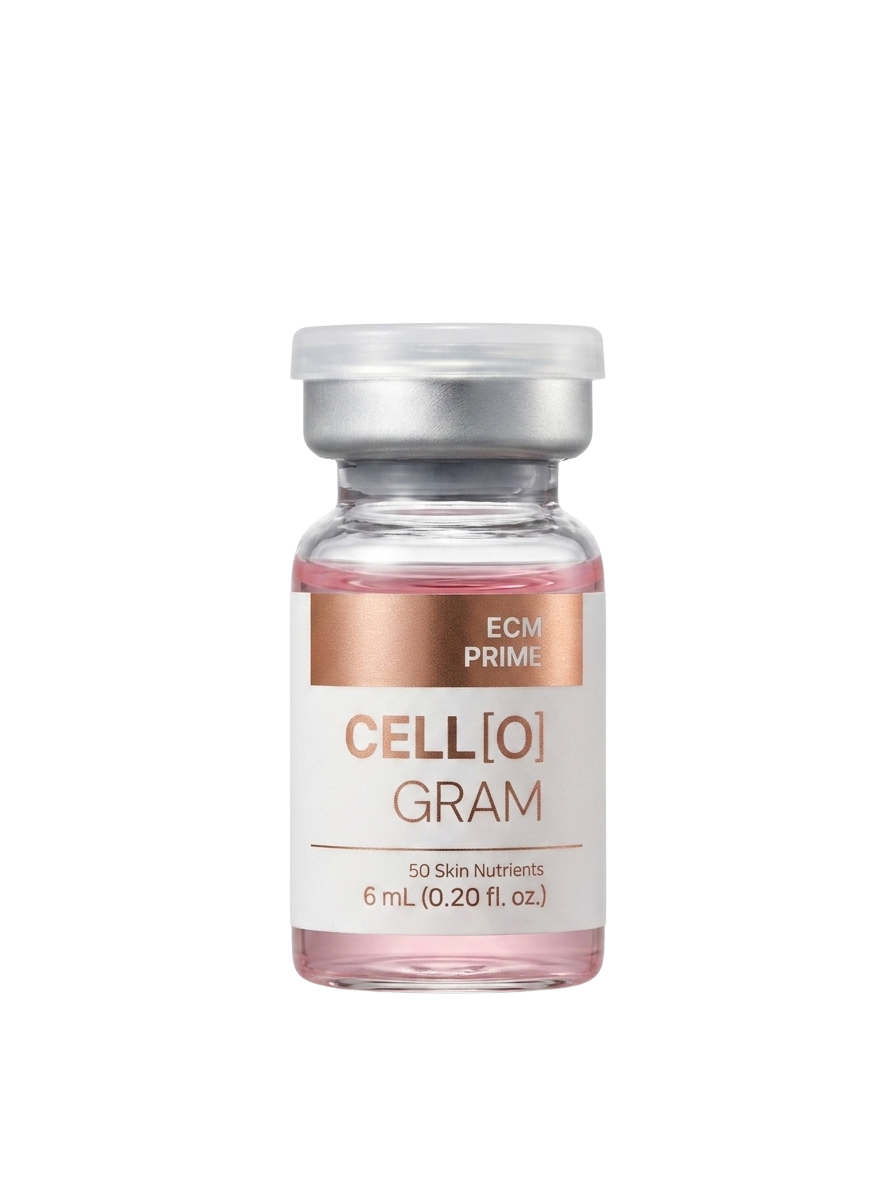
Vial 02 Β· ECM Prime
ECM
Prime
Environment β€” The biological environment where regeneration occurs
Product Specifications
FormAqueous Solution
Volume6mL / vial
Components50+ actives
Categories8 groups
UseProfessional only
"Not volumizing, not filling β€” rebuilding."
Not simply high concentration, but hierarchical design. Within a 4-tier architecture of Foundation, Activation, Protection, and Support, each component organically optimizes the ECM environment.
Explore the Scientific Evidence  →
8 Functional Categories
01 Β· Foundation
Free Hyaluronic Acid
Establishes the foundational hydration environment of the ECM. The base where regeneration begins.
02 Β· Activation
PDRN
DNA fragment regeneration signal. Activates the A2A purinergic receptor to initiate the tissue repair cascade.
03 Β· Activation
Amino Acids (19 types)
Supplies the collagen precursor pool. Proline, Glycine, and Hydroxyproline are the essential building blocks of collagen triple-helix formation.
04 Β· Activation
B Complex + Stable Vit.C
9 B vitamins shift cells from a stimulated state to active regeneration mode. Stabilized vitamin C serves as an essential cofactor for collagen synthesis.
05 Β· Activation
Signal Peptides (9 types)
Precision cell-matrix communication. Growth factor-like activity that elevates the quality of regenerative signaling.
06 Β· Protection
Redox Protection
Glutathione, NAC, and Arbutin block oxidative interference during collagen synthesis, preserving regeneration quality.
07 Β· Support
Minerals & Electrolytes
ECM homeostasis and pH buffering. Maintains enzymatic activity and ensures stability throughout the regeneration cycle.
08 Β· Support
Trehalose
Osmotic stabilization and cellular structure protection. Maintains hydration balance under environmental stress.
Inquire About This Product  →
Protocol Β· For Professional Use
Protocol
CELLOGRAM Γ— Potenza Fusion Tip β€” A core protocol utilizing a triple-action mechanism.
Potenza Needle RF
A medical device that delivers fractional RF energy to dermal tissue through insulated microneedles. Mechanical puncture combined with RF thermal energy simultaneously creates microchannels and thermal coagulation zones within the dermis.
Fusion Tip DDS
The core of drug delivery. The Needle RF itself only opens channels; the active delivery of components is performed by the Fusion Tip's negative-to-positive pressure DDS. This maximizes the penetration of CELLOGRAM.
Triple-Action Mechanism
1. Needle Puncture
Insulated microneedles create physical microchannels in the dermis, activating the wound healing cascade and promoting intrinsic collagen synthesis.
2. RF Thermal Energy
Monopolar RF delivers thermal coagulation to dermal tissue, producing immediate tissue contraction plus long-term neocollagenesis. The coagulation layer prevents excessive deep diffusion of active components.
3. CELLOGRAM Delivery
Through the RF-created channels and coagulation layer, PDLLA 30Β΅m (structure) + ECM Prime 50+ components (environment) are precisely delivered to the reticular dermal target zone, achieving simultaneous fibroblast contact and regenerative environment.
Fusion Tip Drug Delivery Mechanism
The Fusion Tip is Potenza's dedicated drug delivery tip, optimizing dermal delivery of CELLOGRAM components through a 4-step mechanism.
Step 1 Β· Negative Pressure Suction
Negative pressure suctions the skin, ensuring uniform microneedle puncture. Skin adherence guarantees consistent depth control.
Step 2 Β· RF Application
RF energy delivered through insulated microneedles creates a dermal coagulation layer. Thermal channels serve as component pathways.
Step 3 Β· Positive Pressure Delivery
Positive pressure gently delivers CELLOGRAM components in the direction of the RF channels. Components travel along channels into the reticular dermis.
Step 4 Β· Coagulation Layer Retention
The RF coagulation layer prevents excessive deep diffusion of components, maximizing retention within the reticular dermal target zone. This is the key advantage over conventional MTS.
Dual-Pass Protocol
Pass 1 β€” Deep (Structural Rebuilding)
Depth: 1.5–2.0mm Β· Reticular dermis target

Collagen Architecture (PDLLA 30Β΅m) is delivered to the reticular dermis via Fusion Tip. Physical contact at the same scale as fibroblasts (20–30Β΅m) initiates structural regeneration signals.

STRUCTURE
Pass 2 β€” Shallow (Environment Optimization)
Depth: 0.5–1.0mm Β· Papillary dermis

Additional delivery in a cross-hatch direction from Pass 1. ECM Prime's 50+ active components (HA, PDRN, amino acids, vitamins, peptides) distribute uniformly throughout the dermis via RF channels in the papillary dermis.

ENVIRONMENT
STRUCTURE (Pass 1) Γ— ENVIRONMENT (Pass 2) = TRUE REGENERATION β€” Each product is matched to its respective pass in Potenza's dual-pass design.
Recommended Parameters by Area
AreaDepthEnergyPassCELLOGRAM Action
Forehead / Temporal1.5mm15–202PDLLA structural signal + ECM support
Cheeks / Midface2.0mm20–302PDLLA optimal reticular dermis zone
Perioral0.5mm10–151ECM components primary (thin skin)
Neck1.5mm20–302PDLLA + ECM balanced
Periorbital0.5mm10–151ECM components primary, minimal energy
Application timing: immediately after treatment to 5 minutes (channels fully open). Effective up to ~60 minutes (permeability gradually decreases). PDLLA 30Β΅m particles pass freely at 1/5 to 1/10 the channel diameter (160–300Β΅m).
Treatment Procedure
Step 1 Β· Preparation
Prepare CELLOGRAM (dissolve Collagen Architecture in ECM Prime). Attach Fusion Tip to Potenza. Cleanse skin and apply topical anesthetic.
Step 2 Β· Pass 1 Deep
1.5–2.0mm depth. Fusion Tip negative pressure suction, RF application, then positive pressure delivery of Collagen Architecture solution. Refer to area-by-area parameter table.
Step 3 Β· Pass 2 Shallow
0.5–1.0mm depth. Cross-hatch direction from Pass 1. Positive pressure delivery of ECM Prime. Ensures uniform distribution of 50+ active components.
Step 4 Β· Finishing
Apply remaining ECM Prime across the full treatment area. RF coagulation layer prevents deep diffusion, concentrating components in the reticular-to-papillary dermal zone. Apply cooling and soothing care.
Step 5 Β· Post-Treatment Guidelines
Day 0: avoid cleansing, apply sun protection. Days 1–3: mild erythema and swelling are normal. Day 7: barrier recovery and regeneration activation. Day 14: fibroblast activity observed. Day 28: optimal timing for next session (Type I collagen formation begins).
Cumulative Session Design
CELLOGRAM's regeneration pathway is cumulatively designed. The 4-week interval is based on the biological timeline of collagen remodeling, stacking each new stimulus at the point when collagen formation from the previous session begins.
SessionIntervalParametersCumulative Action
Session 1β€”Conservative energy Β· assess responseInitial CELLOGRAM delivery Β· fibroblast first contact
Session 24 weeksResponse-based energy adjustmentRe-stimulation at collagen formation onset (Week 4 = Type I formation begins)
Session 34 weeksOptimized settingsCumulative signal maximization Β· collagen synthesis acceleration
Maintenance3–6 monthsSingle pass or MTSSignal replenishment during PDLLA degradation Β· neo-collagen maturation support
Rationale for 4-week intervals: fibroblasts are observed around PDLLA microspheres from week 2 post-treatment, and Type I collagen formation begins at week 4. More frequent treatments may disrupt M1-to-M2 polarization transition, resulting in more inflammation rather than more collagen.

Expected Clinical Progression
Week 2–4
ECM Prime component action β€” initial improvement in hydration and skin texture
Month 1–2
Fibroblast activation β€” collagen synthesis initiates around the PDLLA scaffold
Month 2–3
PDLLA structural signals in full effect β€” noticeable improvement in elasticity and contour
Month 3–6+
Gradual PDLLA degradation and neo-collagen maturation β€” long-term structural maintenance
PDLLA Mechanism of Action β€” 6 Steps
The process by which PDLLA 30Β΅m microspheres rebuild collagen structure after dermal delivery:
1 Β· DELIVER
PDLLA 30Β΅m microspheres are delivered to the reticular dermis via Potenza Fusion Tip
2 Β· CONTACT
30Β΅m particles make physical contact with fibroblasts (20–30Β΅m) at the same scale. Foreign body response initiates
3 Β· TENSION
Fibroblasts attach to the microsphere surface. Mechanical tension develops on the cell membrane
4 Β· POLARIZE
Tension signals induce M2 macrophage polarization, promoting TGF-Ξ² secretion
5 Β· SYNTHESIZE
TGF-Ξ² signaling upregulates fibroblast Type I/III procollagen synthesis. Collagen formation begins at days 14–28
6 Β· SUSTAIN
Continuous stimulation throughout gradual PDLLA biodegradation (3–6 months). The formed collagen matrix persists even after degradation is complete
PDLLA vs PLLA: CELLOGRAM's PDLLA (Poly-D,L-Lactic Acid) is a D+L copolymer (amorphous), offering a more uniform and predictable degradation profile compared to the semi-crystalline PLLA used in competing products (such as Sculptra), resulting in reduced granuloma risk. The core mechanism (M2 polarization β†’ TGF-Ξ² β†’ collagen) is shared.

1. PDLLA Microsphere Material Research
Mechanism
Type III (early) β†’ Type I (late) sequential collagen synthesis
Following dermal application of PLLA microspheres, initial Type III and subsequent Type I collagen are preferentially stimulated. Fibroblast-to-myofibroblast transition enhances Type I synthesis. HA co-treatment shows additional significant effect on Type I synthesis (p<0.05).
Li X, et al. PubMed, 2025 Β· PMID: 40204932 Β· in vivo (PLLA-based study, core mechanism shared with PDLLA)
Mechanism
TGF-Ξ²1/TIMP1 pathway β†’ Type I/III collagen synthesis activation
Collagen deposition observed from week 2 post PLLA microsphere treatment. Monocyte-to-macrophage differentiation β†’ TGF-Ξ²1 and TIMP1 upregulation β†’ COL1A1 and COL3A1 synthesis pathway activation.
Frontiers Bioeng Biotechnol, 2025;13:1571820
Comparison
Non-porous vs porous: inflammatory cell count at 12 weeks is 1/6
Non-porous microspheres allow surface-only degradation, suppressing rapid release of degradation products. Inflammatory cell count at 12 weeks is significantly lower compared to porous structures (5:30 ratio).
Cao Q, et al. Frontiers Bioeng Biotechnol, 2025;13:1571820

2. PDRN Β· ECM Component Research
Mechanism
PDRN β†’ A2A receptor β†’ fibroblast proliferation
PDRN induces cell growth in human skin fibroblasts via the A2A receptor. Effect is blocked by A2 receptor antagonist (DMPX) β€” directly confirming A2A as the key pathway.
Thellung S, et al. Life Sci, 1999;65(11):1057–71
RCT
FMR + Vitamin C: significant reduction in cellular senescence marker (p16)
FMR + Vitamin C combination group showed significant reduction in cellular senescence marker p16 intensity and significant increase in elastin synthesis compared to FMR alone. Vitamin C is an essential cofactor for proline hydroxylation.
J Dermatol Treat, 2025 Β· double-blind, split-neck placebo-controlled

3. PDLLA Γ— Needle RF Delivery Mechanism Evidence
Mechanism
Fusion Tip DDS: negative-to-positive pressure active delivery maximizes component penetration
The Potenza Fusion Tip uniformly suctions the skin with negative pressure during needle insertion, then actively delivers components toward the channels with positive pressure after RF application. The RF coagulation layer prevents excessive deep diffusion, enabling CELLOGRAM to concentrate within the reticular-to-papillary dermal target zone.
Jeisys Medical, Potenza Clinical Application Guide β€” Fusion Tip DDS mechanism
RCT
PDLLA + Needle RF split-face RCT: significant elevation of dermal procollagen-1, collagen, and elastin
Split-face RCT (n=30) delivering PDLLA through Needle RF channels: the combination group showed histologically significant elevation in dermal procollagen-1, collagen, and elastin. The Needle RF thermal coagulation channels structurally support PDLLA delivery to the reticular dermis.
Kim HJ, et al. Scientific Reports (Nature), 2025;15:18296 β€” PDLLA/MNRF split-face RCT
Fusion Tip-specific clinical data (CELLOGRAM Γ— Potenza Fusion Tip) is currently being accumulated. The above evidence supports the mechanistic validity of CELLOGRAM's core delivery mechanism (PDLLA + RF channel delivery).

Reference Literature
01Li X, et al. "In Vivo Effectiveness of Poly-L-Lactic Acid Microsphere Dermal Fillers in Stimulating Collagen Synthesis." PubMed 2025. PMID: 40204932
02Cao Q, et al. "Faster efficacy and reduced nodule occurrence with PLLA porous microspheres." Front Bioengin Biotechnol 2025;13:1571820
03Thellung S, et al. "Polydeoxyribonucleotides enhance the proliferation of human skin fibroblasts via A2 purinergic receptors." Life Sci 1999;65(11):1057–71
04Kim HJ, et al. "PDLLA/MNRF split-face RCT β€” procollagen-1 Β· collagen Β· elastin elevation." Scientific Reports (Nature), 2025;15:18296
05J Dermatol Treat. "FMR with vitamin C for neck rejuvenation: split-neck placebo-controlled trial." 2025
The evidence cited above is not CELLOGRAM-specific clinical data, but foundational research on the materials, components, and technologies used in CELLOGRAM. The target materials and conditions of each study may differ from CELLOGRAM.
Explore the Science  →
Science Β· Evidence